
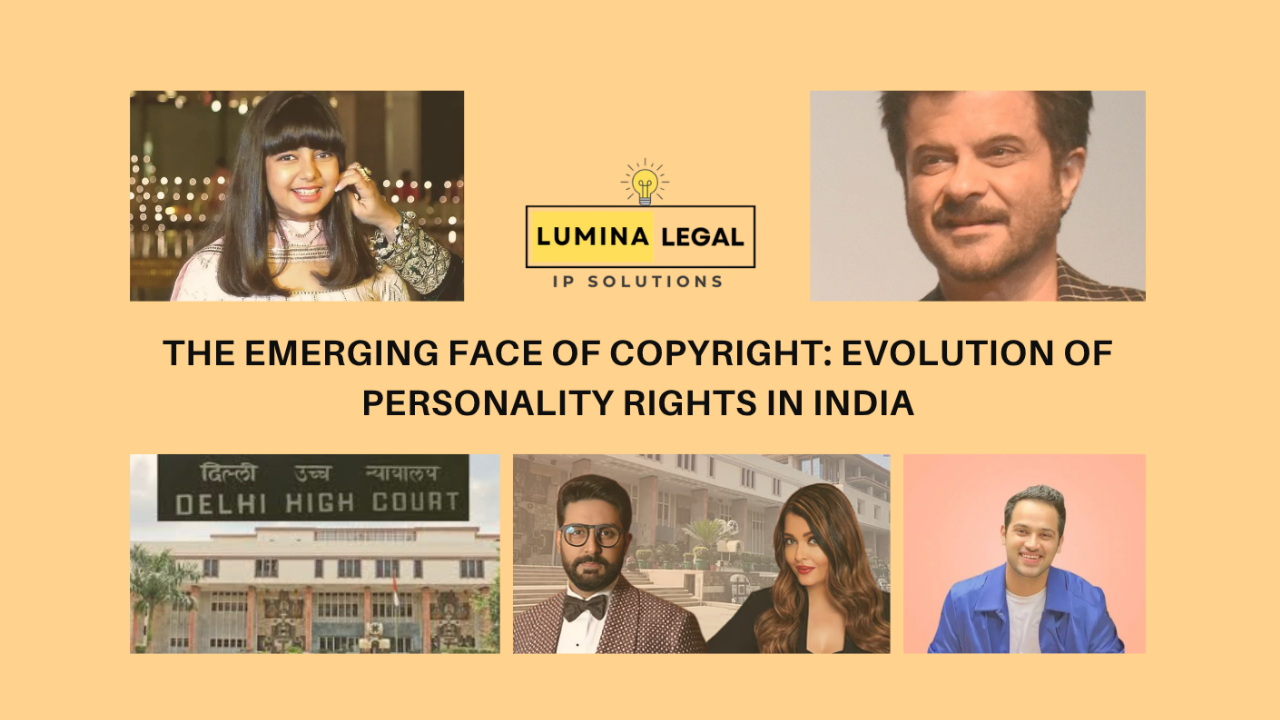
Copyright is an intellectual property right that protects the original work of a creator once it is expressed in a tangible form. It grants the creator exclusive control over the use, reproduction, and distribution of their creative works. Functioning as a legal framework of protection, copyright law ensures that creative expressions receive due recognition and security from unauthorized use.
What are Personality Rights?
Personality rights form a subset of intellectual property rights. They safeguard the commercial and moral interests of individuals particularly celebrities such as actors, sportspersons, and public figures by protecting attributes of their identity such as name, likeness, voice, signature, and overall image from unauthorized commercial exploitation.
Although the Indian Copyright Act, 1957 does not specifically define “personality rights,” Indian courts have progressively recognized and enforced them through judicial interpretation and precedent.
History and Origin of Personality Rights
In the United States
In essence, personality rights empower individuals to control how their persona is used, especially for commercial purposes. The United States pioneered this doctrine. In the landmark case Haelan Laboratories, Inc. v. Topps Chewing Gum Inc., the court recognized that a person possesses the right to control the commercial use of their image, distinguishing it from the traditional right to privacy.
This case laid the foundation for recognizing the “right of publicity” as a distinct legal concept in U.S. jurisprudence, influencing subsequent global recognition of personality rights.
In India
With the expansion of the entertainment and media industries, India saw the growing necessity of protecting individual identities from misuse. In R. Rajagopal v. State of Tamil Nadu, the Supreme Court held that every individual has the right to control the commercial use of their identity. The Court balanced the right to privacy (Article 21) with the freedom of press (Article 19(1)(a)), holding that while media can report on public matters, it cannot intrude into personal life without consent.
This judgment laid the foundation for recognizing personality rights as an extension of the right to privacy and dignity under Article 21 of the Constitution.
Evolution of Personality Rights in India
The evolution of personality rights in India has been gradual and largely judicial in nature. Initially, these rights were seen through the lens of privacy and defamation, but with the rise of celebrity culture and digital media, courts began to treat identity as a form of property that could be commercially exploited or protected.
Over time, Indian courts have expanded the scope of personality rights to include protection against unauthorized endorsements, misuse of AI-generated likenesses, and online defamation. This evolution reflects the intersection between copyright law, the right to privacy, and the right to publicity, making personality rights an emerging frontier in intellectual property protection.
Important Judicial Decisions
1. ICC Development (International) Ltd. v. Arvee Enterprises
The plaintiff alleged that the defendants falsely claimed association with the World Cup, violating its personality rights. The Court rejected this claim, stating that the right of publicity arises only for natural persons and not non-living entities or event organizers.
This case clarified that the right of publicity is personal in nature it belongs to individuals, not corporations or events and cannot be transferred to non-human entities.
2. Titan Industries Ltd. v. Ramkumar Jewellers
The plaintiff, Titan Industries, engaged Amitabh and Jaya Bachchan as brand ambassadors for “Tanishq.” The defendant used identical hoardings to imply a false association with Tanishq. The Court held this as a dishonest act and a violation of copyright and personality rights, restraining the defendant from further misuse.
The judgment reinforced that using a celebrity’s image without consent for commercial gain constitutes a breach of both copyright and personality rights.
3. Anil Kapoor v. Simply Life India & Ors.
The defendants allegedly used AI tools to create and circulate offensive content involving actor Anil Kapoor. The Court granted an ex parte injunction protecting his personality rights and directed authorities like the DoT and MeitY to ensure compliance and domain protection.
This decision highlights how courts are adapting traditional personality rights to modern digital challenges, including AI misuse and online defamation.
4. Aaradhya Bachchan & Anr. v. Bollywood Time & Anr.
The plaintiffs on behalf of the minor Aaradhya Bachchan challenged YouTube videos falsely claiming her illness and death. The Court restrained the defendants from uploading or sharing such misleading and invasive content online.
The ruling extended personality rights protection to minors and emphasized the need for responsible digital communication to preserve the dignity of individuals.
5. Neela Film Productions Pvt. Ltd. v. Taarak Mehta Ka Ooltah Chashmah.com & Ors.
The defendants used AI-generated content and the characters of the popular show Taarak Mehta Ka Ooltah Chashmah to promote their products. The Court issued an ex parte interim injunction prohibiting unauthorized use of the show’s elements and directed ISPs and ministries to block infringing links.
This judgment demonstrates judicial vigilance against unauthorized digital replication of creative works and the misuse of personality-linked characters in the entertainment sector.
Conclusion
Personality rights are an evolving and essential aspect of India’s intellectual property framework. Though not expressly codified under the Copyright Act, courts have recognized their importance in preserving a person’s control over their identity and commercial image. As technology advances, these rights have expanded to include protection from AI-generated likenesses, deepfakes, and unauthorized digital reproductions.
Recently, Raj Shamani, a popular YouTuber and podcaster, approached the Delhi High Court seeking protection of his personality rights after discovering AI-generated content that used his name, face, voice, and likeness without his permission. He has asked the court to order the removal of such content from platforms, restrain unidentified parties from misusing his identity, and safeguard his registered trademarks and copyrighted material arguing that the unauthorized use is harming his reputation and brand value.
The recognition of personality rights not only upholds individual dignity but also strengthens the balance between creative freedom and personal privacy making it an indispensable element of modern copyright and media law.
About author:
Giridhar Dangi is a BBA LL.B. student at Ramaiah Institute of Legal Studies, Bangalore.